By Ralph Schroeder
Online politics is hotly debated, but most research focuses on the West. This book shifts attention to two rising giants - India and China - offering a fresh look at how digital politics works beyond Western democracies.
Read more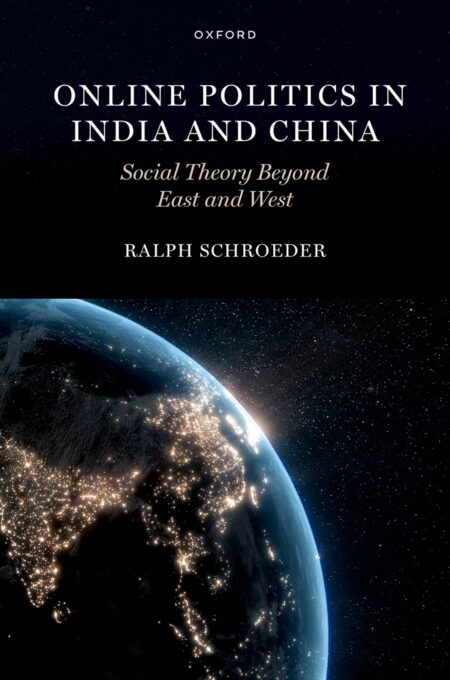

Ralph Schroeder has been at the OII since 2004. He has authored or co-authored more than 170 papers. His recent book publications include ‘Rethinking Science, Technology and Social Change’ (Stanford University Press, 2007), ‘Being There Together: Social Interaction in Virtual Environments’ (Oxford University Press, 2010), ‘An Age of Limits: Social Theory for the 21st Century’ (Palgrave Macmillan 2013), with Eric T. Meyer, ‘Knowledge Machines: Digital Transformations of the Sciences and Humanities’ (MIT Press 2015), ‘Social Theory after the Internet‘ (UCL Press 2018) and ‘Online Politics in India and China: Social Theory beyond East and West’ (Oxford University Press, forthcoming). He is currently working on how AI can be used to develop social theory.
Shared virtual environments; digital media, politics and populism (China, India, Sweden, US); AI for developing social theory
Shared virtual environments, digital media and populism, AI for developing social theory.
If you have questions about my research, you can ask them to this Poe AI Bot
By Ralph Schroeder
Online politics is hotly debated, but most research focuses on the West. This book shifts attention to two rising giants - India and China - offering a fresh look at how digital politics works beyond Western democracies.
Read more

The project will investigate the international relations and social dynamics of international AI competition, specifically the sociopolitical and bureaucratic drivers of US-China AI competition.

This programme supports research on AI, Government and Policy.

This project analyses Sweden's depiction online and in news media by foreign radical groups and how these depictions, in turn gains visibility in Swedish media
In the past five years, my research has been funded by the Volkswagen Foundation, the German Ministry of Education, the Swedish Defence Research Agency (for a study of bots in the Swedish election in 2018), the European Union under Horizon 2020, the Tencent Internet and Society Institute, the European Commission DG Connect, the Arts and Humanities Research Council, the Economic and Social Research Council, the Organization for Economic Cooperation and Development, and the Sloan Foundation.

With Professor Ralph Schroeder
I will argue that non-gatekept online media are here to stay as part of the public arena. They allow counterpublics to challenge elites and traditional media, for better and worse. This has given rise to populism in the US and India.

With Jean Thomas Martelli and Professor Ralph Schroeder
Jean Thomas Martelli analyses Indian Prime Minister Narendra Modi's social media utilisation.

With Professor Ian Milligan
The OII is delighted to welcome Ian Milligan from the University of Waterloo. Ian's research focuses on historians use of web archives, as well as the impact of digital sources on historical practices more generally.

With Dr Victoria Nash, Professor Ralph Schroeder, and Professor Greg Taylor
OII academics Professor Victoria Nash, Professor Ralph Schroeder and Professor Greg Taylor share their reflections on the origins of the MSc programme and its successes.
By Professor Ralph Schroeder
This report provides an overview of how the internet may play a role in promoting the social good, focusing on the areas of the public understandings of history and of climate change.
By Monica Bulger, Greg Taylor, and Ralph Schroeder
How is big data being used in businesses toward growth, and what are the obstacles to its increased use? This report, written by Oxford Internet Institute researchers, answers this question by drawing on interviews with leaders and stakeholders.
18 April 2024
As the world’s most populated country and largest democracy hold its 2024 elections, we consider the role of digital technologies in the election campaign.
27 October 2023
The OII is leading the debate on Artificial Intelligence. Generative AI has been a key area of interest for faculty, researchers and students for many years. This article brings together some of this work to date and highlights forthcoming work.
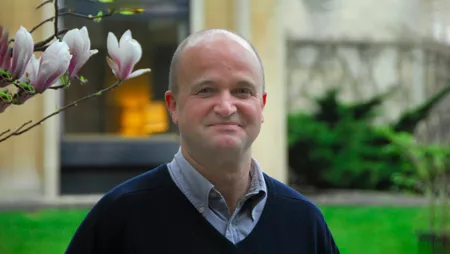
9 May 2023
Professor Ralph Schroeder has been named as a winner of the Achievement Award at the University of Oxford 2023 Divisional Teaching Excellence Awards.
12 January 2021
A study by Oxford University, carried out in partnership with the Leibniz Institute for the Social Sciences, Germany, has found clear evidence of a link between people supporting right-wing political parties and climate change scepticism.

Lawfare, 09 April 2026
Anthropic’s appeals to constitutionalism and virtue-ethics risk obscuring where the power and accountability for shaping AI behavior lies.

The Media Leader, 29 August 2025
Millions of social media users in the EU are posting in languages without any human moderation oversight, according to a new study of recently mandated transparency data under the EU’s Digital Services Act (DSA), conducted by OII researchers.

Hindustan Times, 23 January 2023
We’ve made our peace with doomscrolling. That’s just the way it is, we say — there’s bad news in the world; it comes at us in a steady stream; attached is a string of responses that are inane at best, violent and invasive at worst.
Research Associate
Felix is a Research Fellow in AI and News at the Reuters Institute for the Study of Journalism and a former DPhil student at the OII. A former Leverhulme and Dieter Schwarz Scholar, he researches AI in journalism and the news.
DPhil Student
Manuel is a second-year DPhil student in Social Data Science and a Shirley Scholar at the OII. His research is focused on the cross-geographic study of harmful online content moderation.

DPhil Student
Abid A. Adonis is a DPhil student at OII, interested in Digital Sovereignty, the Politics of Cyberspace, and the intersection between International Relations and technology.

DPhil Student
Mahsa Alimardani is a DPhil candidate that is completing her research part-time at the OII on information controls and political communication in authoritarian settings, with a specific look at Iran.

Former DPhil Student
Tobias Escher has interests in citizen-government relationships online (eParticipation, eGovernment), in political representation as well as e-Social Science methods. He has a background in Communication Studies, Computer Science and Politics.

Former DPhil Student
Han-Teng Liao is a student of various disciplines whose research aims to reconsider the role of keywords (sociolinguistics) and hyperlinks (webometrics) in shaping groups (governance) as bearers of ideas (political communications).
Former DPhil Student
Lucy Power examines the shifting boundaries of the modern life-science laboratory. Her thesis focused on determining the impact of online tools on the research practices of life scientists.
Research Associate
Dr. Pu Yan is an Assistant Professor at Peking University, specializing in computational social science, digital media platforms, and the societal impacts of algorithms.
This course will introduce to some of the fundamental questions that have been raised in this domain across the social sciences.
This course examines how AI can be used to improve policymaking and governance. The course will explore how AI can be used to develop, evaluate, and implement better policies; as well as the technical and organizational conditions that enable AI-driven policymaking.
An overview of the major findings to date regarding the social implications of the Internet, drawing material from several social science disciplines, including communication studies, sociology, and political science.