

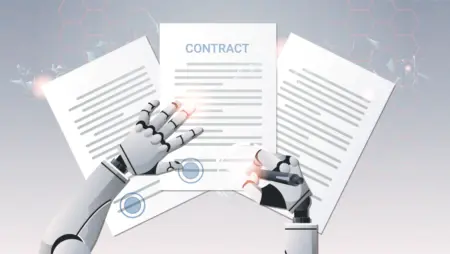
The New Era of Lawyerless Contracting
22 July 2026
Contract generators, platforms, and AI are reshaping consumer contracts. Luka Nenadic explains how and highlights the potential pitfalls and policy implications.
The Oxford Internet Institute (OII) is a multidisciplinary research and teaching department at the University of Oxford, dedicated to exploring the implications of emerging technologies for how people live, work and govern.
22 July 2026
Contract generators, platforms, and AI are reshaping consumer contracts. Luka Nenadic explains how and highlights the potential pitfalls and policy implications.

15 July 2026
Social networking interoperability is a leading policy proposal that gives users a real choice of platform providers. New evidence shows it only works if regulators get the specifics right, argues Philipp Riederle, doctoral researcher, OII.

9 July 2026
New analysis from researchers at the Oxford Internet Institute reveals that users of artificial intelligence tools are increasingly turning to them for personal support, emotional advice, and companionship.
We examine the opportunities and challenges posed by transformative innovations such as artificial intelligence, machine learning, digital platforms, and autonomous agents.

With Dr Andrew Graham, Professor Richard Susskind OBE, Professor William H. Dutton, Professor Helen Margetts, Dr Victoria Nash, and Professor Scott A. Hale
As part of the OII's 25th Anniversary celebrations, Dr Andrew Graham, Prof Richard Susskind, OBE, Prof Bill Dutton, Prof Helen Margetts and Dr Vicki Nash join us to look back on the early days of the OII.

With Dr danah boyd
In this talk, danah will weave through internet pasts, presents, and future to shed light on the good, bad, and ugly so that we may leverage our knowledge of what happened in pursuit of a more just and generous future.

With Dr Fabian Stephany
The OII's Dr Fabian Stephany reflects on a recent LSE study that explored the relationship between remote work and AI automation pressure on specific job roles.
Our work is multidisciplinary and multi-method. We bring together diverse academic traditions to study the digital age through qualitative, quantitative and computational approaches.

With gig work rapidly expanding, how can research help make the platform economy fairer for workers?

How data concentration by dominant digital firms affects competition and innovation.

The challenge: is screen time really harmful?
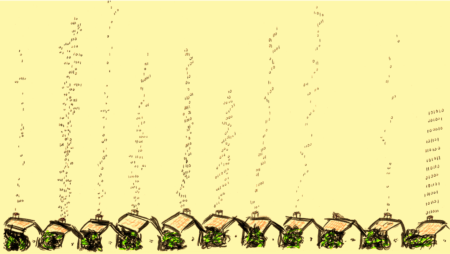
The Synthetic Society Lab aims to improve how we research, access, and use sensitive human data. The fellowship will advance an evidence-based science of privacy engineering to make research using digital traces safe and reliable.

This project investigates how worker representation in German firms shapes AI use and adoption, asking whether employee voice at firms can steer AI toward complementing workers rather than automating them.

The project will investigate the international relations and social dynamics of international AI competition, specifically the sociopolitical and bureaucratic drivers of US-China AI competition.
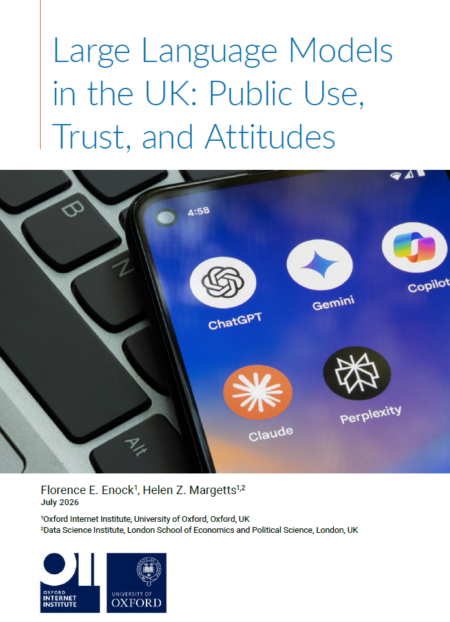
By Florence Enock and Helen Margetts
New report finds UK adults increasingly seek emotional support and companionship from AI

Vox, 20 July 2026
People are increasingly sceptical of AI because they see it as an elite project, with new commentary from the OII's Prof. Carl Frey.

New York Times, 29 July 2026
The OII's Prof. Carl Frey comments on the AI arms race between the US and China.

The Wall Street Journal, 31 July 2026
In the U.S., regulation can protect incumbents while discouraging entrepreneurs. China gives startups room to grow before cracking down on founders. The OII's Prof. Carl Frey discusses China's dynamism in WSJ's The Saturday Essay.