Skip down to main content

Informing EU policy on digital platform work

Delivery

Informing EU policy on digital platform work

The challenge: digital transformation of EU labour markets

As online platforms reshape Europe’s labour markets, data-driven gig work is growing rapidly. But this transformation raises concerns: workers often face low pay, isolation, and weak protections, while policymakers struggle to regulate platform labour with outdated tools. Vili Lehdonvirta’s work has helped the European Commission better understand how digital platforms are reshaping these markets.

Key findings

  • Platforms offer flexibility but use algorithmic systems to manage labour, often leading to low pay, poor working conditions, and a lack of worker autonomy.
  • Power asymmetries limit worker mobility. Workers are often unable to move freely between platforms due to practices such as reputation data lock-in and restricted access to client information.
  • Traditional employment protections don’t fit. Platform workers are frequently classified as self-employed, leaving them excluded from basic rights such as collective bargaining and social protection.
  • Official labour market statistics fail to capture the size and nature of platform work, making evidence-based policy difficult.
  • Data reporting could formalise gig work. Platforms could be required to share income data with governments to simplify tax and social security collection and reduce fraud.

The research

Vili Lehdonvirta’s research highlighted how algorithmic management shapes working conditions, and how the structure of platform markets weakens worker power.

From research to policy and practice

The evidence from this research informed the EU’s Platform-to-Business (P2B) Regulation (2019), which requires platforms to explain how algorithms rank workers and disclose the data they withhold.

Lehdonvirta also contributed to shaping the EU’s Digital Services and Tax Packages (2020). His research, conducted with Daisy Ogembo, explored how countries could collect tax and social contributions from platform workers by directly accessing income data from platforms – a model that inspired the “Digital Single Window” concept now under development.

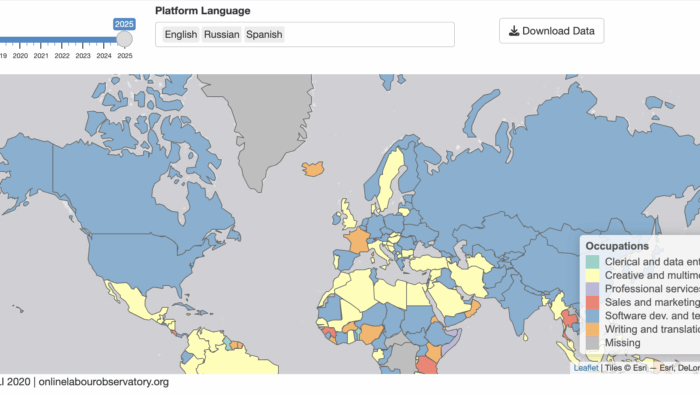
To support long-term regulation, Lehdonvirta co-developed the Online Labour Index (OLI), a tool for tracking platform work globally. As chair of an EU expert subgroup, he helped integrate this tool into recommendations for monitoring the platform economy, ensuring future policy is grounded in accurate data.

He also helped draft key recommendations as part of the EU High-Level Expert Group on the Digital Transformation of Labour. These include extending collective bargaining rights to platform workers, building technology-neutral social protections, and creating integrated reporting systems for taxes and benefits. These proposals continue to influence evolving EU policy.

Online Labour Index

This work was supported by the European Research Council project “Online Labour: The Construction of Labour Markets, Institutions and Movements on the Internet” (2015–2021).

Privacy Overview
Oxford Internet Institute

This website uses cookies so that we can provide you with the best user experience possible. Cookie information is stored in your browser and performs functions such as recognising you when you return to our website and helping our team to understand which sections of the website you find most interesting and useful.

Strictly Necessary Cookies
  • moove_gdrp_popup -  a cookie that saves your preferences for cookie settings. Without this cookie, the screen offering you cookie options will appear on every page you visit.

This cookie remains on your computer for 365 days, but you can adjust your preferences at any time by clicking on the "Cookie settings" link in the website footer.

Please note that if you visit the Oxford University website, any cookies you accept there will appear on our site here too, this being a subdomain. To control them, you must change your cookie preferences on the main University website.

Google Analytics

This website uses Google Tags and Google Analytics to collect anonymised information such as the number of visitors to the site, and the most popular pages. Keeping these cookies enabled helps the OII improve our website.

Enabling this option will allow cookies from:

  • Google Analytics - tracking visits to the ox.ac.uk and oii.ox.ac.uk domains

These cookies will remain on your website for 365 days, but you can edit your cookie preferences at any time via the "Cookie Settings" button in the website footer.