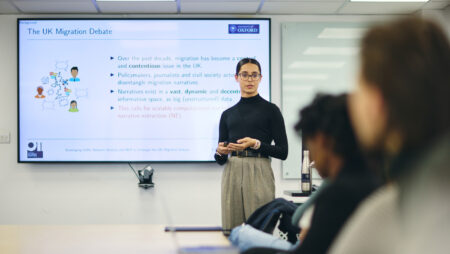





Beyond the hype: Oxford & Berlin study uncovers four faces of ChatGPT’s early adopters
28 January 2026
New international study identifies four distinct archetypes of early AI users and challenges the "one-size-fits-all" notion of AI adoption.
28 January 2026
New international study identifies four distinct archetypes of early AI users and challenges the "one-size-fits-all" notion of AI adoption.

23 January 2026
Dr Victoria Nash, Associate Professor and Senior Policy Fellow at the Oxford Internet Institute, researches the governance challenges of digital technologies, with a particular focus on online safety, content moderation and platform regulation.
20 January 2026
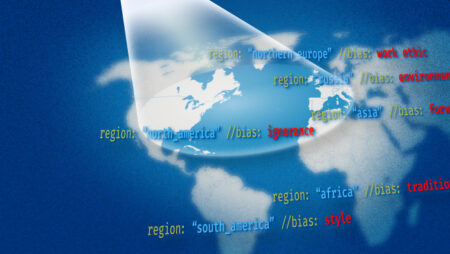
New analysis from Oxford and Kentucky researchers shows AI systems reproduce long‑standing global biases
15:30 -17:00, Teams
With Dr Janet SalmonsFunny thing about change: sometimes it goes forward and sometimes it circles back. For a time, it seemed like email and user-created blogs were going extinct in favor of social media. Now those trends appear to be reversing.
Find out more about research by OII academics

Associate Professor Digital South Asian Studies
Janaki's research examines the politics of digital exclusion in India. She uses ethnographic and archival research to examine how gender, caste and class have shaped the use of information and information technologies in varied contexts.

Professor of Data Ethics and Policy
Professor Brent Mittelstadt is a data ethicist and philosopher specializing in AI ethics, professional ethics, and technology law and policy. He is the founder/coordinator of the Governance of Emerging Technologies (GET) programme.

Director of Graduate Studies, Associate Professor, Senior Research Fellow
Bernie Hogan examines how to capture, represent and think about social networks, especially personal social networks. His work focuses on the role of design in social media, network capture techniques and theories of relationships.

This project investigates how worker representation in German firms shapes AI use and adoption, asking whether employee voice at firms can steer AI toward complementing workers rather than automating them.

The Synthetic Society Lab aims to improve how we research, access, and use sensitive human data. The fellowship will advance an evidence-based science of privacy engineering to make research using digital traces safe and reliable.

The project will investigate the international relations and social dynamics of international AI competition, specifically the sociopolitical and bureaucratic drivers of US-China AI competition.
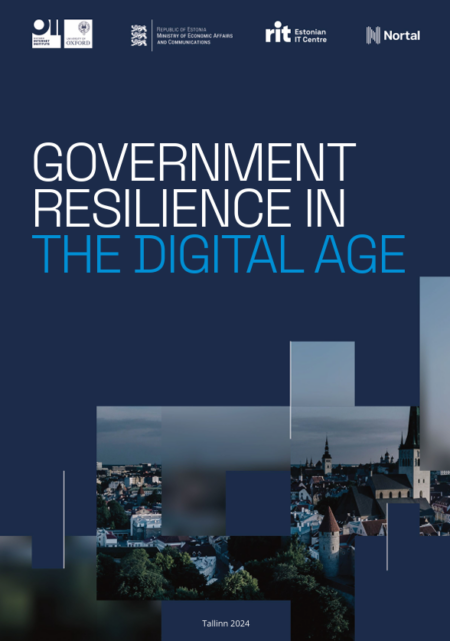
By Andres Raieste, Andri Rebane, Madis Tapupere, Keegan McBride
In a world increasingly defined by crises—from pandemics and climate disasters to escalating wars—governments that fail to build digital resilience risk crumbling under pressure.

Die ZEIT, 04 February 2026
Thirteen years ago, Dr Carl Benedikt Frey warned that 47 percent of all jobs could be automated. And today? He sees a surprising number of reasons for optimism.

Folha De S Paulo, 03 February 2026
New research co-authored by Prof Mark Graham finds ChatGPT amplifies global inequalities.

New York Times, 03 February 2026
Where Is A.I. Taking Us? The OII’s Prof Carl Frey shares his vision.