By Ralph Schroeder
Online politics is hotly debated, but most research focuses on the West. This book shifts attention to two rising giants - India and China - offering a fresh look at how digital politics works beyond Western democracies.
Read more

Artificial intelligence (AI) is of growing importance to our everyday lives, whether used to serve up relevant content on social media, write quick-response news stories, or make key decisions in autonomous cars. But, as well as opportunities, it poses a broad set of challenges, from the technical to the legal to the ethical.
Our researchers consider the full range of questions on AI. Projects on AI have built on the concept of ‘counterfactual explanations’ to explain complex ‘black-box’ decision-making and asked about the benefits and risks of the introduction of AI into domestic work. OII researchers have also written reports on how AI could be deployed in local government and healthcare, as well as setting out the different levels of support for the use of AI around the world.
By Ralph Schroeder
Online politics is hotly debated, but most research focuses on the West. This book shifts attention to two rising giants - India and China - offering a fresh look at how digital politics works beyond Western democracies.
Read more

UK policy makers are facing a teacher recruitment and retention crisis, driven by workload and the changing nature of teachers’ work. This project explores how AI reconfigures teachers' work, and the implications for workload, identity and pedagogy.

This project seeks to understand how citizens listen and speak to public institutions, and how alternative AI-based models and framing might encourage democratic communication.

With mobile devices ubiquitous among young people, it is not surprising that parents are increasingly turning to technology for help in childcare. This project examines monitoring technologies and how parents use them as part of child supervision.



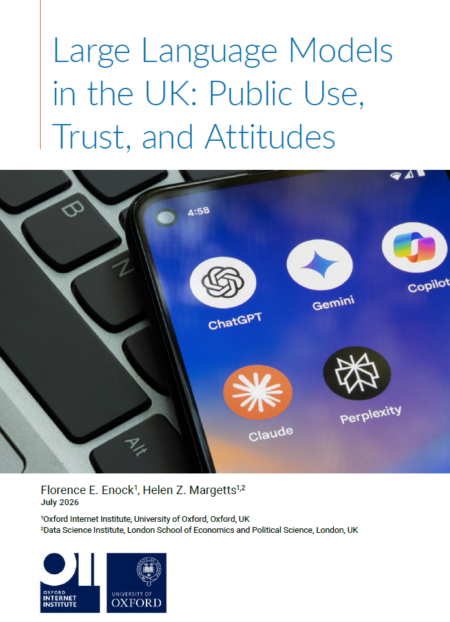
By Florence Enock and Helen Margetts
New report finds UK adults increasingly seek emotional support and companionship from AI

6 July 2026
AI tools used to generate, edit or contextualise social media posts can introduce hidden biases that spread through online networks and shape public opinion, according to new research from the OII and the Hasso Plattner Institute.

2 July 2026
In an age of AI chokepoints, Europe’s choices will depend on the capacities it builds now. The OII's Johanna Ballesteros and TUM Think Tank's DR Nicklas Berild Lundblad explain why.

24 June 2026
A new working paper by OII researchers argues that EU technology policy should hold AI companies to account for actual public wellbeing, not just reduced risk.

15 June 2026
Researchers and DPhil students from the Oxford Internet Institute are set to attend the Association of Computing Machinery (ACM) Conference on Fairness, Accountability and Transparency (FAccT) in Montréal, from 25-28 June 2026.

The Deep View, 08 July 2026
Emotional support and advice have long been difficult to come by, prompting a growing number of people to turn to AI for more help, finds new research led by the OII's Dr Florence Enock.

FT, 09 July 2026
Disinformation and deepfakes are known risks but biased LLMs could also be used to influence public opinion with commentary from Prof. Sandra Wachter.

Computer Weekly, 08 July 2026
The public is in all but name a shareholder of AI companies - it is time that the public receives socially beneficial technology in return for its investment argues Prof. Sandra Wachter.