Skip down to main content

Large Language Models in the UK: Public Trust and Attitudes

By Florence Enock and Helen Margetts
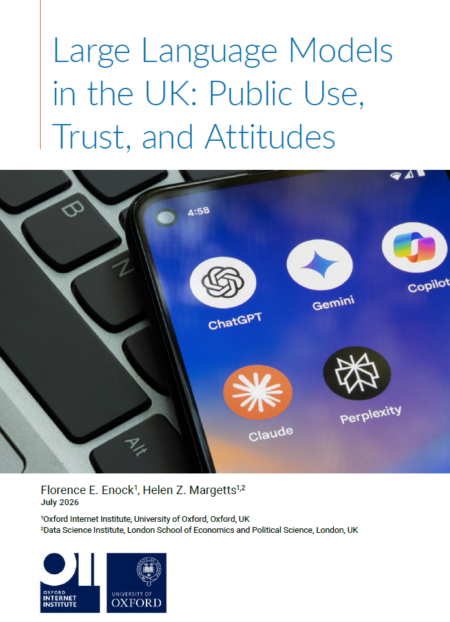
Cover of Large Language Models in the UK: Public Trust and Attitudes

Large Language Models in the UK: Public Use, Trust and Attitudes 

By Dr Florence Enock and Professor Helen Margetts 

Users of artificial intelligence tools are increasingly turning to them for personal support, emotional advice, and companionship, reflecting a wider societal shift toward seeking care and connection through technology. That’s the central finding of a new report from the Oxford Internet Institute, based on a survey of large language models in the UK. 

The report highlights how UK users are looking to AI for real personal guidance and trusting it for advice across a range of topics, including personal relationships.  

Key findings on LLM usage  

  • Almost one third of regular users (31%) reported using LLMs for personal and emotional support, such as talking through problems and asking for help with decisions, while one quarter reported interacting with LLMs for meaningful conversation at least occasionally. 
  • 38% of those surveyed said they trust LLMs for advice on personal relationships 
  • Younger users were more likely to use LLMs across all types of activity that were asked about, from practical help and collaboration to role play with AI characters and deep conversations with AI chatbots 
  • Women were more likely than men to use LLMs for personal and emotional support, whereas men turned to AI for help with practical tasks to a greater extent than women. 
  • 75% of respondents are enthusiastic about the possible benefits of AI chatbots, though men are consistently more enthusiastic than women  
  • Two thirds of respondents (67%) reported trusting LLMs for information about health issues. 

Read the full report, Large Language Models in the UK: Public Use, Trust and Attitudes by Dr Florence Enock and Professor Helen Margetts. 

Related Topics:

Privacy Overview
Oxford Internet Institute

This website uses cookies so that we can provide you with the best user experience possible. Cookie information is stored in your browser and performs functions such as recognising you when you return to our website and helping our team to understand which sections of the website you find most interesting and useful.

Strictly Necessary Cookies
  • moove_gdrp_popup -  a cookie that saves your preferences for cookie settings. Without this cookie, the screen offering you cookie options will appear on every page you visit.

This cookie remains on your computer for 365 days, but you can adjust your preferences at any time by clicking on the "Cookie settings" link in the website footer.

Please note that if you visit the Oxford University website, any cookies you accept there will appear on our site here too, this being a subdomain. To control them, you must change your cookie preferences on the main University website.

Google Analytics

This website uses Google Tags and Google Analytics to collect anonymised information such as the number of visitors to the site, and the most popular pages. Keeping these cookies enabled helps the OII improve our website.

Enabling this option will allow cookies from:

  • Google Analytics - tracking visits to the ox.ac.uk and oii.ox.ac.uk domains

These cookies will remain on your website for 365 days, but you can edit your cookie preferences at any time via the "Cookie Settings" button in the website footer.