Attend In Person
35 tickets remaining.
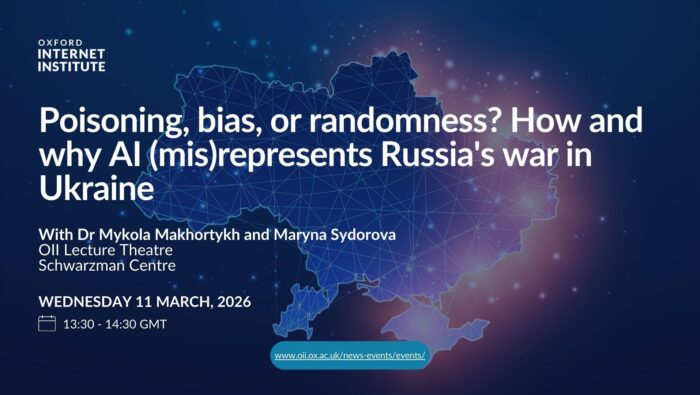
How do advances in AI technologies change the representation of modern wars, particularly Russia’s war in Ukraine? To what degree are such representations prone to poisoning, bias, or stochasticity, and what methods can we use to study these risks? And what can be the implications of the different forms of AI (mis)representation for how wars are perceived today and will be perceived in the future? To address these questions, we will discuss results from a series of studies in which we explored how text- and image-generative AI applications represent different aspects of Russia’s war in Ukraine.
Speaker biographies
Mykola Makhortykh is an Alfred Landecker lecturer at the Institute of Communication and Media Science, where he studies politics- and history-centred information behaviour in online environments and how it is affected by the algorithm- and AI-driven systems. His other research interests include trauma and memory studies, armed conflict reporting, disinformation and computational propaganda research, cybersecurity and critical security studies, and bias in information retrieval systems.
Maryna Sydorova is a data engineer and scientific programmer specializing in the study of AI systems and the development of large-scale research infrastructures. At the University of Bern and the University of Fribourg, I lead the development of cross-platform AI audit frameworks designed to study how complex systems shape information exposure. My background combines AI, deep learning, and cloud computing, and my current work focuses on developing research techniques for investigating the performance of search engines, generative AI models, and applications. My research interests include the impact of AI on disinformation production and dissemination.
35 tickets remaining.
Attend In Person
Attend Online

Alfred Landecker lecturer, Institute of Communication and Media Science
Mykola studies politics- and history-centred information behaviour in online environments and how it is affected by the algorithm- and AI-driven systems.
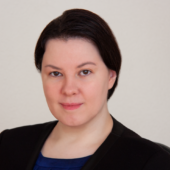
Data engineer and scientific programmer
Maryna specializes in the study of AI systems and the development of large-scale research infrastructures.