Skip down to main content

Governing Artificial Intelligence in the Anthropocene

With Professor Julia Velkova and Dr Sy Taffel
Date & Time:
16:30 - 18:30,
Wednesday 18 March, 2026
Location:
Schwarzman Centre
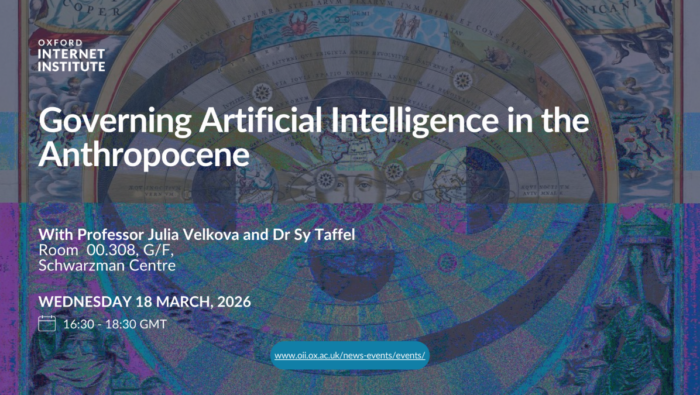
The image shows an illustration of celestial chart featuring concentric rings with Latin inscriptions and zodiac symbols, centered around a sun with a face and 4 plants around it. The upper portion displays angel-like figures in a deep blue border, while the lower half is awash in psychedelic colors—pinks, blues, and greens that create a glitch effect. This distortion partially obscures classical figures or statues at the bottom. The overall composition mixes Renaissance-era astronomical imagery with contemporary digital art techniques.
Cristóbal Ascencio & Archival Images of AI + AIxDESIGN / https://betterimagesofai.org / https://creativecommons.org/licenses/by/4.0/

About

This event features two keynotes by Professor Julia Velkova (Linköping University, Sweden) and Dr Sy Taffel (Massey University, New Zealand), who will discuss how to regenerate the materiality of the digital technologies, and more concretely of AI, in the Anthropocene.

Repairing the Sustainable Cloud, Prof Julia Velkova, Linköping University

Abundance, the Anthropocene, and AI, Dr Sy Taffel, Massey University

Over the past decade, the visibility of data infrastructure triggered by its global expansion has raised awareness of the infrastructural complex that underpins digitalised societies. As AI scales up, both in tangible and intangible forms, it becomes ever more urgent to discuss how to govern the socio-environmental consequences of its materiality. Within this context, Professor Velkova’s keynote, Repairing the Sustainable Cloud,  will guide us through innovative ways to interrogate media infrastructures and their interconnections with time, energy, and the environment. Dr  Taffel will deliver a keynote titled Abundance, the Anthropocene, and AI, examining the ecological, material, cultural, and political affordances of digital technologies. The session will be chaired by Dr Valdivia (Oxford Internet Institute), whose transdisciplinary expertise combines computational and ethnographic methods to investigate how the materiality of AI contributes to the Anthropocene.


Speaker biographies

Julia Velkova is professor of media and culture at Linköping University and Profutura Scientia fellow at the Swedish Collegium for Advanced Study. Her research examines media infrastructures and their relation to time, energy and environment.
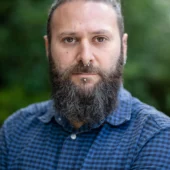
Sy Taffel is a Senior Lecturer in Media Studies and co-director of the Political Ecology Research Centre at Massey University, Aotearoa-New Zealand. His research focuses upon the ecological, material, cultural, and political affordances of digital technologies.

Attend In Person

EVENTS: IN PERSON Governing Artificial Intelligence in the Anthropocene
First
Last

43 tickets remaining.

Julia Velkova

Professor Julia Velkova

Professor of media and culture, Linköping University

Julia is a Profutura Scientia fellow at the Swedish Collegium for Advanced Study. Her research examines media infrastructures and their relation to time, energy and environment.

Sy Taffel

Dr Sy Taffel

Senior Lecturer in Media Studies and co-director of the Political Ecology Research Centre, Massey University

Sy's research focuses upon the ecological, material, cultural, and political affordances of digital technologies.

Privacy Overview
Oxford Internet Institute

This website uses cookies so that we can provide you with the best user experience possible. Cookie information is stored in your browser and performs functions such as recognising you when you return to our website and helping our team to understand which sections of the website you find most interesting and useful.

Strictly Necessary Cookies
  • moove_gdrp_popup -  a cookie that saves your preferences for cookie settings. Without this cookie, the screen offering you cookie options will appear on every page you visit.

This cookie remains on your computer for 365 days, but you can adjust your preferences at any time by clicking on the "Cookie settings" link in the website footer.

Please note that if you visit the Oxford University website, any cookies you accept there will appear on our site here too, this being a subdomain. To control them, you must change your cookie preferences on the main University website.

Google Analytics

This website uses Google Tags and Google Analytics to collect anonymised information such as the number of visitors to the site, and the most popular pages. Keeping these cookies enabled helps the OII improve our website.

Enabling this option will allow cookies from:

  • Google Analytics - tracking visits to the ox.ac.uk and oii.ox.ac.uk domains

These cookies will remain on your website for 365 days, but you can edit your cookie preferences at any time via the "Cookie Settings" button in the website footer.