

Skip down to main content

Policy engagement

Johann Laux

Policy engagement

The Oxford Internet Institute (OII)’s research plays a vital role in enabling effective, forward-looking policymaking in the digital age. We provide rigorous, interdisciplinary insight into how digital technologies are reshaping economies, democracies, and societies, and how evidence-based policy and regulation can help harness digital transformation for public good.

Our work supports decision-makers to respond to complex challenges such as regulating AI, misinformation, algorithmic bias, digital harms, and digital exclusion. At the same time, we help unlock opportunities for inclusive economic growth, innovation, and trustworthy digital infrastructure.

Policy impact

We collaborate with national and local governments, international organisations, civil society, think tanks and parliamentary bodies to help decision-makers navigate a rapidly changing landscape. Our research is frequently cited in policy papers, given in evidence to government consultations and inquiries, presented to parliamentary groups, used to shape regulation, and presented at global policy forums. Here are just a few examples:

AI and work

Professor Carl-Benedikt Frey’s work on automation, labour markets, and data regulation has shaped policy discussions across Europe. His research has been featured in VoxEU, Project Syndicate, and reports by Citi Global Insights and the Tony Blair Institute, and cited by the World Bank, IMF, and World Economic Forum.

AI, government, and policy

Professor Chris Russell researches algorithmic fairness and legal accountability in AI. His work, published in Royal Society Open Science and featured in Nature and New Scientist, has influenced ethical frameworks and tools used by public institutions, including the NHS Clinical AI Fellowship.

Ethical AI and law

Professors Sandra Wachter and Brent Mittelstadt have influenced policy and business practices through their work on AI explainability and algorithmic bias. Their methods have been cited by the UK Government, European Commission, and adopted by Google, Vodafone, IBM, and Accenture.

Discover more about how OII makes an impact.

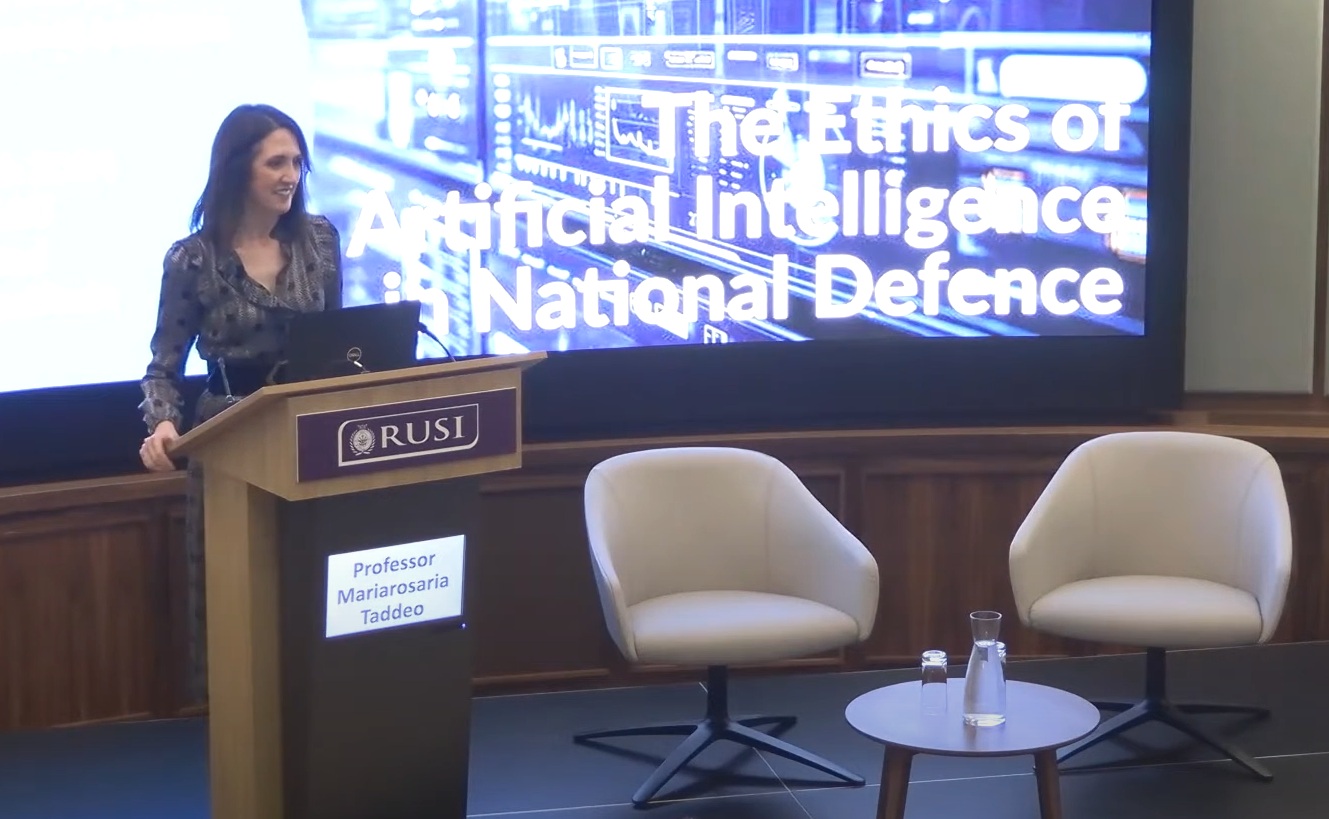
Professor Mariarosaria Taddeo gives a lecture on The Ethics of AI in National Defence at RUSI (Royal United Services Institute)

Policy events

The OII designs, delivers and contributes to policy events and regularly invites politicians and policymakers to speak. For example:

  • In 2025, we co-hosted a speaker event with the Blavatnik School of Government, where H.E. Liisa-Ly Pakosta, Minister of Justice and Digital Affairs of the Republic of Estonia spoke about ‘Safeguarding digital government’.
  • In 2024, we ran a series of events on the digital aspects of the elections that happened in a year when two billion people were eligible to vote in more than 60 countries across the globe.
  • As part of the Oxford Policy Engagement Network Showcase 2022, OII Visiting Policy Fellows and Faculty shared their experiences of informing public policy in data and technology in an EU, UK and global context.


Dr Fabian Braesemann bridges academic and public debate through his event series 'Digital Future - Democratic Future' at the Einstein Center Digital Future in Berlin.'

Policy programmes

At the Oxford Internet Institute (OII), we provide executive education programmes that equip leaders from government and civil society with the critical understanding and strategic tools they need to navigate the changes brought about through digital transformation.

For example, we ran a Google-supported, invitation-only short course for global policy and thought leaders, fostering informed debate on key digital policy challenges. The course comprised lectures, seminars and panel sessions led by OII faculty.

Partner with us

We invite policymakers, regulators, and public institutions to collaborate with us, whether through collaborative research, advisory roles, events, or co-designed programmes.

Privacy Overview
Oxford Internet Institute

This website uses cookies so that we can provide you with the best user experience possible. Cookie information is stored in your browser and performs functions such as recognising you when you return to our website and helping our team to understand which sections of the website you find most interesting and useful.

Strictly Necessary Cookies
  • moove_gdrp_popup -  a cookie that saves your preferences for cookie settings. Without this cookie, the screen offering you cookie options will appear on every page you visit.

This cookie remains on your computer for 365 days, but you can adjust your preferences at any time by clicking on the "Cookie settings" link in the website footer.

Please note that if you visit the Oxford University website, any cookies you accept there will appear on our site here too, this being a subdomain. To control them, you must change your cookie preferences on the main University website.

Google Analytics

This website uses Google Tags and Google Analytics to collect anonymised information such as the number of visitors to the site, and the most popular pages. Keeping these cookies enabled helps the OII improve our website.

Enabling this option will allow cookies from:

  • Google Analytics - tracking visits to the ox.ac.uk and oii.ox.ac.uk domains

These cookies will remain on your website for 365 days, but you can edit your cookie preferences at any time via the "Cookie Settings" button in the website footer.