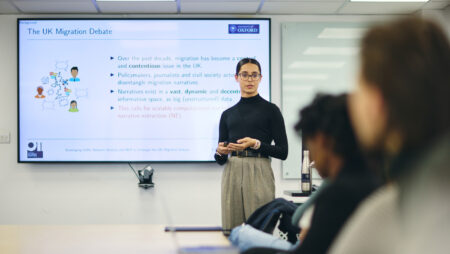





The efficiency paradox in EU data centre policy
8 May 2026
New EU reporting rules for data centre energy and water use may look like progress, but loopholes risk undermining genuine environmental accountability.
8 May 2026
New EU reporting rules for data centre energy and water use may look like progress, but loopholes risk undermining genuine environmental accountability.

29 April 2026
New Oxford research shows that training chatbots to sound warmer makes them up to 30% less accurate, and 40% more likely to validate users' false beliefs.

24 April 2026
Whether Europe shapes the next technological paradigm or simply inherits it depends on one overlooked distinction.
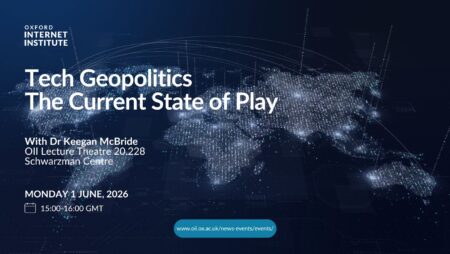
With Dr Keegan McBride
15:00 - 16:00, Schwarzman Centre
This talk will explore the nexus of technological innovation, geopolitics, and security.
With Emilie Munch Gregersen and Professor Morten Axel Pedersen
15:30 - 17:00, 58a Banbury Road
Via hands-on examples, this talk will explore how Ethnote enables systematic workflows while maintaining the open-endedness of anthropological knowledge making.
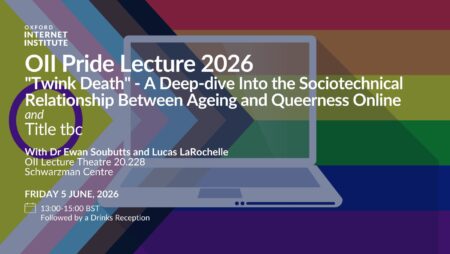
With Dr Ewan Soubutts and Lucas LaRochelle
13:00 - 15:00, Schwarzman Centre
"Twink Death - A Deep-dive Into the Sociotechnical Relationship Between Ageing and Queerness Online" with Dr Ewan Soubutts and title tbc with Lucas LaRochelle
Find out more about research by OII academics

Associate Professor Digital South Asian Studies
Janaki's research examines the politics of digital exclusion in India. She uses ethnographic and archival research to examine how gender, caste and class have shaped the use of information and information technologies in varied contexts.

Professor of Data Ethics and Policy
Professor Brent Mittelstadt is a data ethicist and philosopher specializing in AI ethics, professional ethics, and technology law and policy. He is the founder/coordinator of the Governance of Emerging Technologies (GET) programme.

Director of Graduate Studies, Associate Professor, Senior Research Fellow
Bernie Hogan examines how to capture, represent and think about social networks, especially personal social networks. His work focuses on the role of design in social media, network capture techniques and theories of relationships.

The Synthetic Society Lab aims to improve how we research, access, and use sensitive human data. The fellowship will advance an evidence-based science of privacy engineering to make research using digital traces safe and reliable.

This project investigates how worker representation in German firms shapes AI use and adoption, asking whether employee voice at firms can steer AI toward complementing workers rather than automating them.

The project will investigate the international relations and social dynamics of international AI competition, specifically the sociopolitical and bureaucratic drivers of US-China AI competition.
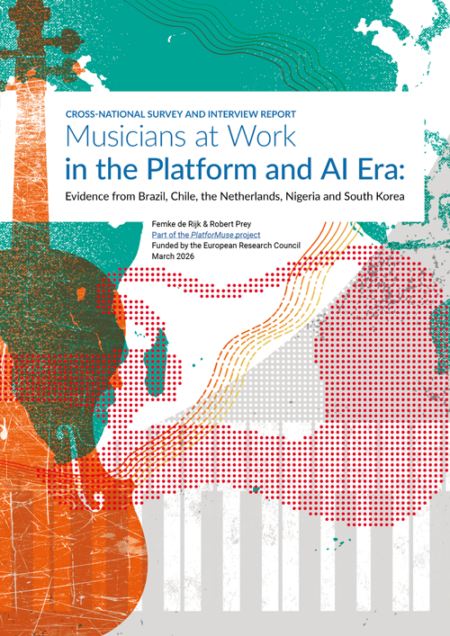
By Femke de Rijk and Robert Prey
A new report from the Oxford Internet Institute and the University of Groningen identifies the 'streaming paradox' with evidence from five countries - Brazil, Chile, the Netherlands, Nigeria and South Korea.

Reuters, 20 May 2026
Dr Fabian Braesemann was quoted in Reuters as major banks including HSBC and Standard Chartered began signalling job cuts driven by AI adoption.

ARTE, 18 May 2026
Prof. Sandra Wachter shares her perspective about why AI regulation isn’t a barrier to ai innovation but rather the foundation for developing a technology that puts people first.

Rest of World, 18 May 2026
For $7 an hour, virtual assistants use AI tools to write LinkedIn posts and comments on behalf of Western executives. The OII's Mark Graham comments.