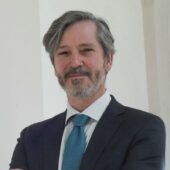
Giuseppe Abbamonte
Director for Media Policy, European Commission’s Directorate-General for Communications Networks, Content and Technology (DG CONNECT)
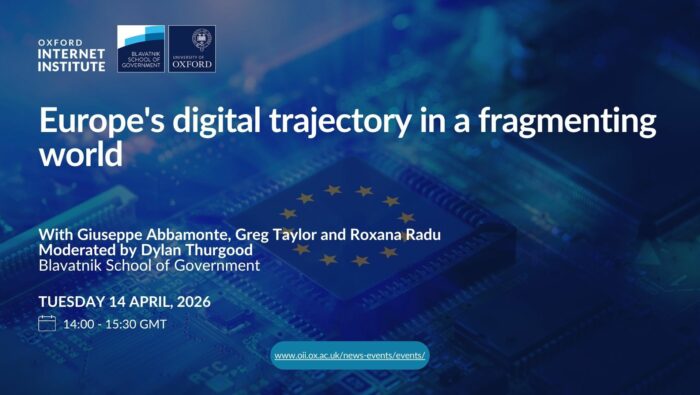
Join us for a roundtable discussion on “Europe’s digital trajectory in a fragmenting world”, jointly hosted by the Blavatnik School of Government and the Oxford Internet Institute.
Giuseppe Abbamonte, Director for Media Policy at the European Commission’s Directorate-General for Communications
Networks, Content and Technology (DG CONNECT)
Greg Taylor, Professor of Digital Markets and Competition at the Oxford Internet Institute
Roxana Radu, Associate Professor of Digital Technologies and Public Policy at the Blavatnik School of Government
Dylan Thurgood, DPhil Candidate at the Oxford Internet Institute
The current geopolitical tensions and the rapid pace at which digital technologies are transforming our societies not only create significant strategic and security challenges, but also opportunities for economic growth. How can Europe become a digital superpower?
This session will unpack how the policy objectives of the European Commission’s Digital Single Market Strategy have evolved over the past 10 years, how the landscape of competition policy is shifting, and the implications this has for global tech governance.
Please note that the roundtable discussion takes place in person only. Refreshments and snacks will be provided.
Director for Media Policy, European Commission’s Directorate-General for Communications Networks, Content and Technology (DG CONNECT)

Professor of Digital Markets and Competition
Greg Taylor's research focuses on the economics of competition policy and regulation for digital and technology markets.

Associate Professor of Digital Technologies and Public Policy , Blavatnik School of Government, , University of Oxford
Roxana is passionate about technology governance& building a better digital future. She serves on the Advisory Group of the EU Cybersecurity Agency & advises governments & international organisations.

DPhil Student
Dylan Thurgood is a third-year DPhil in Social Data Science student and was previously a student on the MSc in Social Data Science. His research focuses on how online news exposure shapes political attitudes.