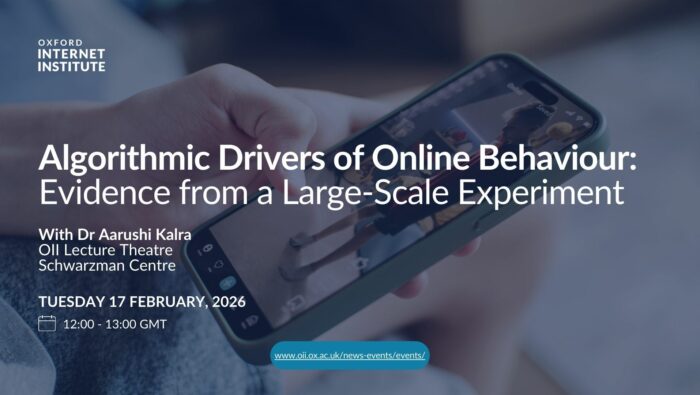
12:00 - 13:00,
Tuesday 17 February, 2026
Schwarzman Centre
About
Social media algorithms are thought to amplify variation in user beliefs, thus contributing to radicalization. However, quantitative evidence on how algorithms and user preferences jointly shape harmful online engagement is limited. I conduct an individually randomized experiment with 8 million users of an Indian TikTok-like platform, replacing algorithmic ranking with random content delivery. Exposure to “toxic” posts decreases by 27%, mainly due to reduced platform usage by users with higher interest in such content. Strikingly, these users increase engagement with toxic posts they find. Survey evidence indicates shifts to other platforms. Model-based counterfactuals highlight the limitations of blanket algorithmic regulation.
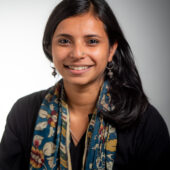
Dr Kalra is an applied microeconomist researching the digital economy and AI in under-regulated environments. Broadly, Aarushi’s research examines how social identity drives exclusion both online and offline, and analyzes its impact on economic development. Aarushi is a co-founder of Bahujan Economists, a platform for social science researchers from historically marginalized castes, and communities in India. Dr Kalra is currently a Postdoctoral Prize Research Fellow at Department of Economics and Nuffield College, Oxford University. Aarushi completed her PhD from Brown in 2025.
Attend Online
Speaker
Dr Aarushi Kalra
Postdoctoral Prize Research Fellow, Department of Economics and Nuffield College, Oxford University
Aarushi's research examines how social identity drives exclusion both online and offline and analyzes its impact on economic development. Dr Kalra is a co-founder of Bahujan Economists