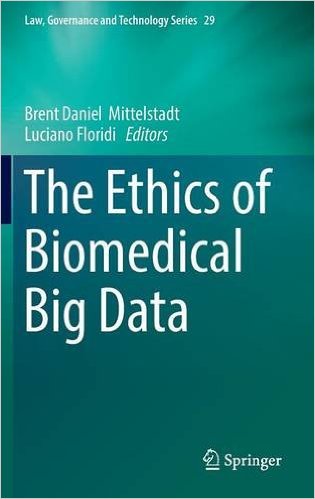
The Ethics of Biomedical Big Data
By Brent Daniel Mittelstadt (Editor) and Luciano Floridi (Editor)
This book presents cutting edge research on the new ethical challenges posed by biomedical Big Data technologies and practices.
Read more

The internet and new technologies present equally new ethical dilemmas: Should we use automated decision-making systems that are incompressible to the people they effect? How should our personal data be handled after our deaths? To what degree can firms and states use our data to make inferences about our activities and wants?
Our researchers work at the forefront of internet ethics. Our projects tackle both theoretical questions – like the possibility of explaining complex ‘black-box’ algorithms – and more practical ones – like the content of a new European ethical code for post-humous medical data donation.
By Brent Daniel Mittelstadt (Editor) and Luciano Floridi (Editor)
This book presents cutting edge research on the new ethical challenges posed by biomedical Big Data technologies and practices.
Read more

Based on a case-study analysis of bias in the Chicago Crime Prediction Algorithm, this project explores the extent to which evidence of algorithmic bias can be used to guide policy responses to the societal disparities replicated in these tools.
This project will evaluate the effectiveness of accountability tools addressing explainability, bias, and fairness in AI. A ‘trustworthiness auditing meta-toolkit’ will be developed and validated via case studies in healthcare and open science.
This project transforms the concept of counterfactual explanations into a practically useful tool for explaining automated black-box decisions.
24 June 2026
A new working paper by OII researchers argues that EU technology policy should hold AI companies to account for actual public wellbeing, not just reduced risk.
15 June 2026
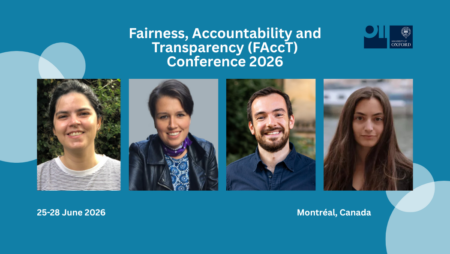
Researchers and DPhil students from the Oxford Internet Institute are set to attend the Association of Computing Machinery (ACM) Conference on Fairness, Accountability and Transparency (FAccT) in Montréal, from 25-28 June 2026.
29 April 2026
New Oxford research shows that training chatbots to sound warmer makes them up to 30% less accurate, and 40% more likely to validate users' false beliefs.
23 January 2026
Dr Victoria Nash, Associate Professor and Senior Policy Fellow at the Oxford Internet Institute, researches the governance challenges of digital technologies, with a particular focus on online safety, content moderation and platform regulation.
Die ZEIT, 14 June 2026
Mithilfe meiner Daten habe ich einen KI-Agenten geschaffen. Er ruft für mich im Restaurant an, plaudert mit Kollegen und führt Interviews. Leider: besser als ich.
Fortune Magazine, 16 June 2026
As Washington's decision to cut off global access to Anthropic's most powerful AI models sent shockwaves through governments and institutions, Prof Sandra Wachter shared her perspective with Fortune Magazine.
Al Jazeera, 15 June 2026
As the UK proposes banning under-16s from social media, OII DPhil Bhargav Srinivasa Desikan asks whether targeting users, rather than the product, is really the right approach.