Skip down to main content

Musicians at Work in the Platform and AI Era

By Femke de Rijk and Robert Prey
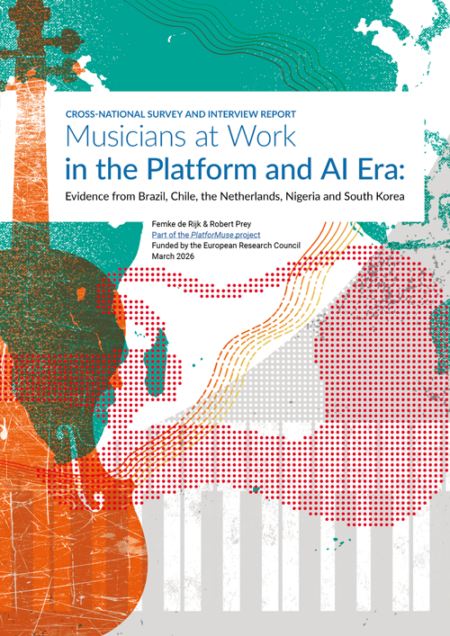
Cover of Musicians at Work in the Platform and AI Era

Musicians across the globe are grappling with a shared contradiction: streaming platforms are now essential for building a career – yet they rarely provide enough income to sustain one.  

That’s the central finding of a new report from the Oxford Internet Institute and the University of Groningen, which surveyed around 1,200 musicians in Brazil, Chile, the Netherlands, Nigeria and South Korea. 

The study identifies what researchers call the “streaming paradox”: while streaming has made it easier than ever for artists to reach audiences, it has not translated into meaningful financial returns. Many musicians say they now feel compelled to act as content creators and audience managers, constantly posting, promoting and engaging online simply to remain visible. 

The reports argues that cultural expectations, economic conditions and local industry structures shape how artists navigate the platform era in fundamentally different ways. 

Key findings on streaming income and work conditions 

  • 77% of surveyed musicians earn less than €10,000 a year from music. 
  • 83% are dissatisfied with the royalties they receive from streaming services. 
  • 81% say streaming is important for their career, yet fewer than half feel their situation has improved because of it. 
  • Lower income musicians are the most likely to describe streaming as “extremely important,” while higher earners are more likely to say it is “not that important.” 
  • 23% spend more than half their working time on tasks such as social media, tour planning and fan communication — rising to 30% in Chile. 
  • 69% say they now spend more time promoting their music online than they did a few years ago. 
  • 89% do not use AI or automation tools when interacting with fans. 
  • Dutch musicians are the most concerned about AI generated music flooding streaming platforms and competing with humanmade work. 

Read the full report, Musicians at Work in the Platform and AI Era, by Femke de Rijk and Dr Robert Prey.   

Details

Publication date:
April 2026
Privacy Overview
Oxford Internet Institute

This website uses cookies so that we can provide you with the best user experience possible. Cookie information is stored in your browser and performs functions such as recognising you when you return to our website and helping our team to understand which sections of the website you find most interesting and useful.

Strictly Necessary Cookies
  • moove_gdrp_popup -  a cookie that saves your preferences for cookie settings. Without this cookie, the screen offering you cookie options will appear on every page you visit.

This cookie remains on your computer for 365 days, but you can adjust your preferences at any time by clicking on the "Cookie settings" link in the website footer.

Please note that if you visit the Oxford University website, any cookies you accept there will appear on our site here too, this being a subdomain. To control them, you must change your cookie preferences on the main University website.

Google Analytics

This website uses Google Tags and Google Analytics to collect anonymised information such as the number of visitors to the site, and the most popular pages. Keeping these cookies enabled helps the OII improve our website.

Enabling this option will allow cookies from:

  • Google Analytics - tracking visits to the ox.ac.uk and oii.ox.ac.uk domains

These cookies will remain on your website for 365 days, but you can edit your cookie preferences at any time via the "Cookie Settings" button in the website footer.