Research

New technologies, data, and algorithms impact every aspect of daily life. It takes multidisciplinary research to investigate how we design, build and adapt to new innovations.
It takes many kinds of qualitative, quantitative, and computational methods, crafted ethically, to understand how we socialise, how we learn, and how we can solve social problems. Our faculty are the global leaders in this research.
A significant proportion of social, economic, and political activity across the world has moved online, and our mission is to understand this transformation. Our research draws on many different disciplines: we believe this combined approach is essential to tackle society's 'big questions'.
Professor Brent Mittelstadt
Professor of Data Ethics and Policy

Every day, more of the world’s cultural, economic and political activity takes place online. The Oxford Internet Institute’s (OII) mission is to understand this transformation. Our research draws on many different disciplines, essential to tackling the major challenges of the 21st century. From digital politics to the ethics of artificial intelligence, we aim to address the societal implications of life online to inform public policy, advise industry and enhance daily life for people around the world.
Our research excellence strategy involves a comprehensive program for conducting original research, recruiting the world’s top researchers, and advancing both the scientific and humanistic understanding of the impact of the internet, data, and information technologies on society.
We have a consolidated agenda – across our research and teaching activities — that addresses important questions for public life, develops our strengths in key domains of inquiry, emphasises methodological innovation, and engages in international and collaborative research.
Our research is organised in eight broad themes, where the Internet is having a significant effect on social, economic and political activity worldwide.
From geography to philosophy, and from data science to public policy, our research is firmly multi-disciplinary. The research that we do isn’t constrained by disciplinary boundaries: rather, it breaks them. We believe that this combined approach is essential to tackle society’s ‘big questions’.

The project will identify weaknesses in general and sectoral regulatory mechanisms—such as the limited protections afforded to inferences in data protection law—and argue for greater accountability by establishing a ‘right to reasonable inferences'.

This project builds on existing data science to understand the extent to which credible public health information is outweighed by false content on social media and measure the effectiveness of public health communication responses in real‐time.

How might the future of consumption change how we track and monitor ourselves? This project will test different strategies for helping people make healthier choices in online food shopping.
Our research contributes both to academic knowledge and debates as well as to policy and practice, and we have had a significant impact on policy debate, formulation and implementation around the globe, as well as a secondary impact on people’s wellbeing, safety and understanding.
Our impact in scholarly publishing is significant, but we go beyond this with methodological innovations, tool building, engagement with industry, and active participation in wider debates about the role of technology in public life.
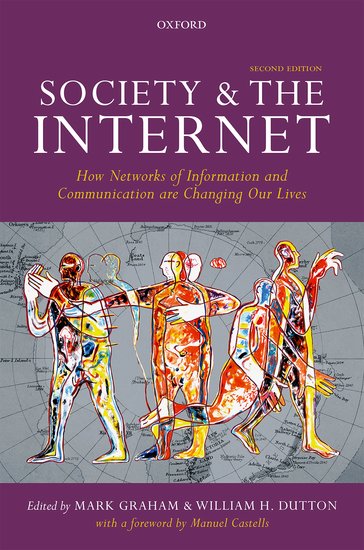
By Mark Graham (Editor) and William Dutton (Editor)
How is society being reshaped by the continued diffusion and increasing centrality of the Internet in everyday life and work? This volume addresses the big questions about one of the most significant technological transformations of this century.

Newsweek, 10 July 2025
The AI revolution isn't ahead of us; it's here. But, for a technology that's been heralded as the future, it risks bringing with it problems from the past.

Pixel Parenting, 25 June 2025
In Part 2 of a special series with Dr. Nick Ballou, postdoctoral researcher at the Oxford Internet Institute, the Pixel Parenting podcast team dives into what research actually says about the effects of video games on mental health.
Pixel Parenting, 04 June 2025
In this first part of a two-part series, Dr. Nick Ballou, a postdoctoral researcher at the Oxford Internet Institute, pulls back the curtain on how video game research is actually done.